1. Sentence Construction
Two common ways to ask in American English:
- "How's the weather today?" (or "How is the weather today?")
- "What is the weather like today?"
Yes/No questions (Direct questions):
We usually ask directly using "Is it + [adjective]?":
- "Is it hot?"
- "Is it sunny today?"
- "Is it cold outside?"
- Nota: decir "Is the weather hot?" es gramaticalmente correcto pero suena redundante en inglés y casi nunca se usa.
How to answer:
- "Yes, it is." / "Yes, it's hot."
- "No, it isn't. It's cool today."
- "It's sunny and warm."
Describing Ongoing Weather (Present Continuous, se verá más adelante en el año.)
- It's raining. (Está lloviendo)
- It's snowing. (Está nevando)
2. Golden Rules
-
Which verb to use?
-
In Spanish, we use "hace" or "está" (hace calor, hace frío, está lloviendo). In English, we use the verb "to be".
-
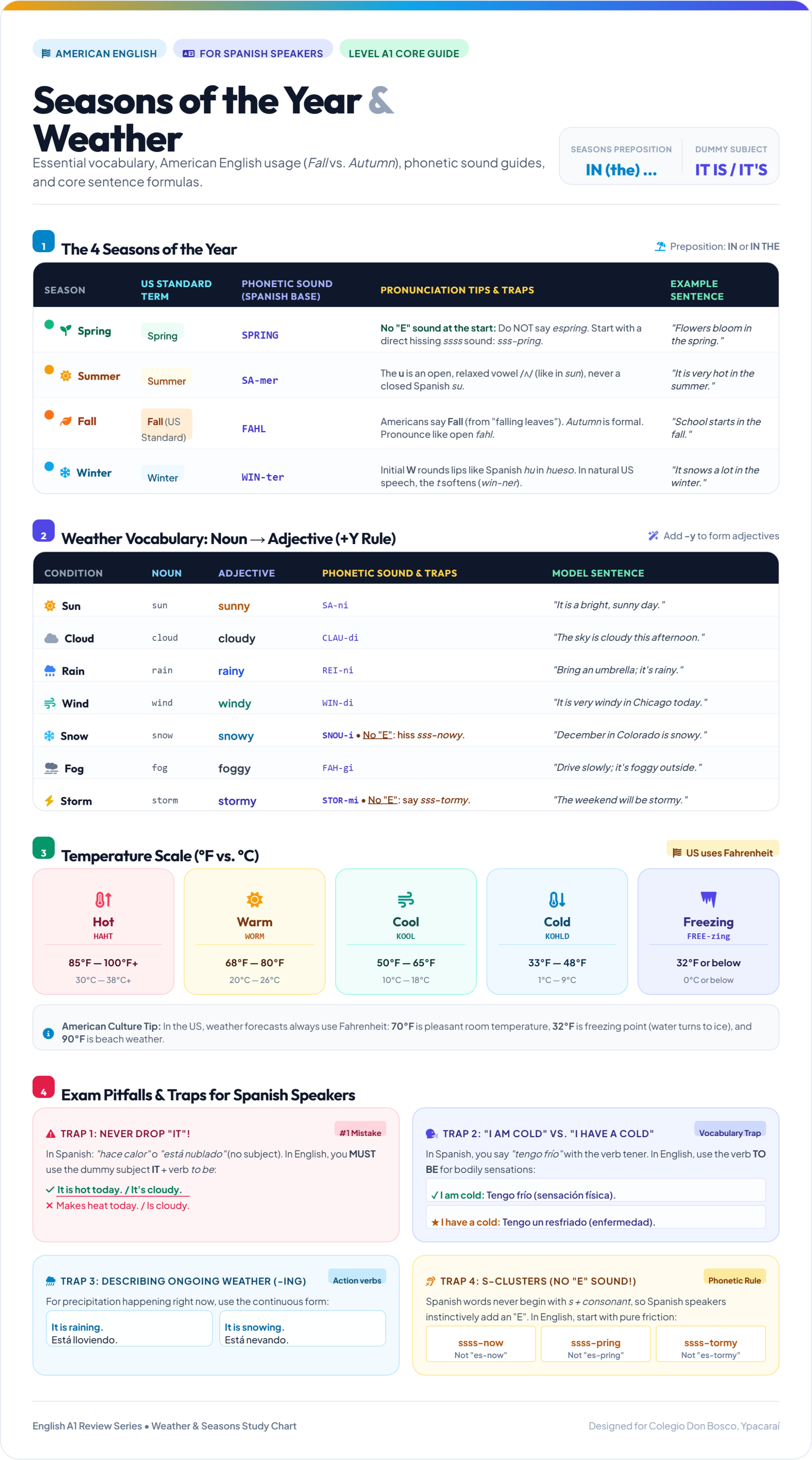
In English, we cannot drop the subject. We use dummy pronoun "It" + the verb "to be" (It + is = It's):
-
Correct: It's hot. / It's cold.
-
Incorrect: Is hot. / Makes cold.
-
-
-
Key Preposition Rule
-
Always use the preposition IN with seasons:
-
I love to go to the beach in the summer. (or in summer)
-
Leaves turn orange in the fall.
-
It snows a lot in the winter.
-
-
3. US Culture Note
In the United States, temperature is measured in Fahrenheit (°F), not Celsius (°C).
- 70°F is comfortable / warm (aprox. 21°C)
- 32°F is freexing point (0°C)
- 90°F or more is very hot (aprox. 32°C)
In the United Kingdom, temperature is measured in Celsius.
The Four Seasons (Seasons of the Year)
| Season | US Alternative | Pronunciation for Spanish Speakers | Sound & Pronunciation Notes |
| Spring | — | SPRING | No "E" at the start: Do not say espring. Start with pure friction: sss-pring. |
| Summer | — | SA-mer | The u is open and relaxed (like the u in sun), not Spanish su. |
| Fall | Autumn | FAHL | In the US, Fall is the standard everyday word (Autumn is more formal). Sounds like fahl, not fa-ul. |
| Winter | — | WIN-ter | Start with English W (rounded lips like Spanish hu in hueso). Flap / smooth American t-er. |
Describing the Weather
| Condition / Noun | Adjective | Pronunciation (Spanish base) | Example Sentence |
| Sun | Sunny | SA-ni | It's sunny today. |
| Cloud | Cloudy | CLAU-di (sounds like clau) | It's cloudy this afternoon. |
| Rain | Rainy | REI-ni | Take an umbrella; it's a rainy day. |
| Wind | Windy | WIN-di (short i) | It's very windy outside. |
| Snow | Snowy | SNOU-i (no initial e) | December can be snowy. |
| Fog | Foggy | FAH-gi (open American ah) | The morning is foggy. |
| Storm | Stormy | STOR-mi (no initial e) | The skies look stormy. |
Temperature Words
| Temperature | Meaning / Level | Pronunciation Guide | Watch Out |
| Hot | Muy caluroso | HAHT | The "o" sounds like an open "ah", and the "H" is aspirated like a soft Spanish j. |
| Warm | Agradable / templado | WORM | Rhymes with storm. |
| Cool | Fresco | KOOL | Long "oo" sound. |
| Cold | Frío | KOHLD | Starts with an aspirated "c/k" sound. |
| Freezing | Extremadamente frío / congelando | FREE-zing | Vibrating Z sound (like a buzzing bee). |
False Friends & Translation Traps (Errores más comunes)
-
"Hace calor" no se traduce como "Makes heat" ni como "Is hot":
-
Incorrect: Makes heat today. / Is hot today.
-
Correct: "It is hot today." / "It's hot today."
-
-
"I have cold / I am with cold" tienen significados diferentes:
-
If a person feels cold: "I am cold." (Never: "I have cold").
-
If a person is sick with a cold: "I have a cold." (Tengo un resfrío)
-
-
The S-Cluster Pronunciation. No comenzar las palabras con "E" sino directamente con una "S":
-
Words like Snow, Spring, and Stormy do not start with the vowel "E".
-
Practice having students hiss like a snake first: "ssss-now", "ssss-pring".
-
Exercise 1: Choose the Correct Form (It's / Prepositions)
Complete each sentence with the correct option:
-
(Is / It's) ________ very cold outside; wear a jacket.
-
My family usually goes on vacation ________ (in / on) the summer.
-
Today is a beautiful, ________ (sun / sunny) afternoon.
-
Leaves fall from the trees ________ (in / at) the fall.
-
Take a raincoat because it's ________ (rain / raining).
Exercise 2: Correct the Mistake
Find and fix the error in each sentence:
-
Makes very hot in Florida during July. → ____________________________________
-
I like spring because is warm. → ____________________________________
-
We go skiing on the winter. → ____________________________________
-
It's a very wind day today. → ____________________________________
-
I have cold! Can you close the window? → ____________________________________
Exercise 3: Pair Speaking Drill (American Context)
Puedes hacer con un compañero este ejercicio para practicar la pronunciación de las preguntas y respuestas::
-
Student A: "What's your favorite season?"
-
Student B: "My favorite season is [Season] because it's [warm / cool / sunny]."
-
Student A: "How is the weather today?"
-
Student B: "It's [hot / cold / cloudy / windy]."
-
Student A: "What's the weather like in New York in the winter?"
-
Student B: "It's freezing and snowy!"
Answer Key (Respuestas)
-
Exercise 1:
-
It's (Dummy pronoun "It" is required)
-
in (Seasons take "in")
-
sunny (Adjective modifying afternoon)
-
in (Seasons take "in")
-
raining (Continuous action)
-
-
Exercise 2:
-
Makes very hot... → It is very hot in Florida during July.
-
...because is warm. → I like spring because it is (or it's) warm.
-
...on the winter. → We go skiing in the winter.
-
...wind day... → It's a very windy day today.
-
I have cold! → I am cold! (or I'm cold!)
-
More exercises
There are many more exercises at Liveworksheets!
If you want you can practice with a lot of exercises at Liveworksheet. (Recuerda que puedes completar los ejercicios en la misma página web y luego hacer la corrección presionando el botón "Finish!" que se encuentra luego del ejercicio).